
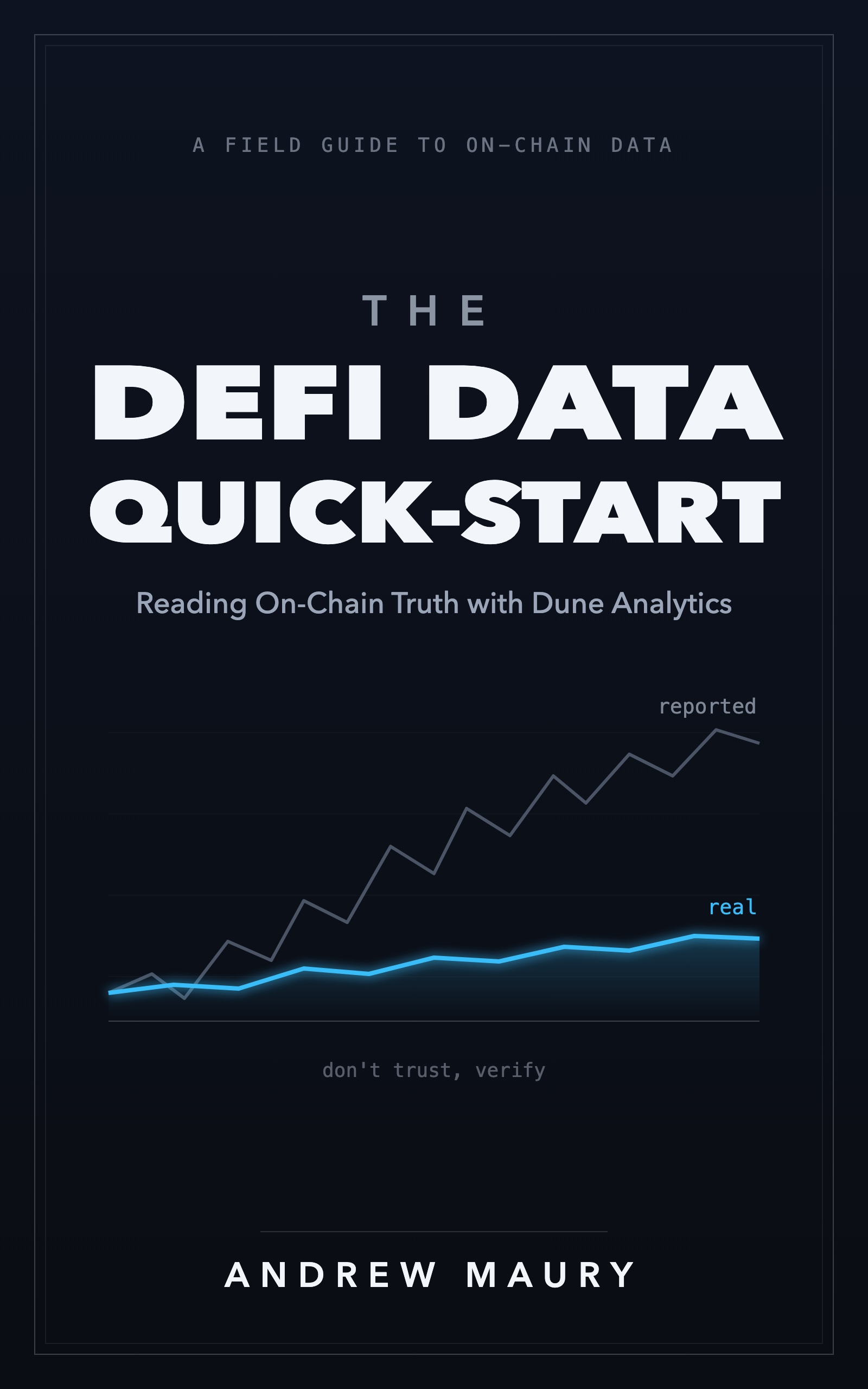
The live example
ClearTrace: the neutral DEX execution-intelligence dashboard and API the book's methodology chapters draw on: cross-frontend attribution, sandwich detection, and execution-quality measurement across Ethereum, Base, Arbitrum, and Optimism.
Work along with the book
- Dune Analytics: make a free account; every query in the book runs on the free tier.
- Dune documentation: the query editor, DuneSQL reference, and table schemas.
- Spellbook: the open-source models behind
dex.tradesand the curated tables (Chapter 5). - Dune Data API: programmatic query execution, for Chapter 10's architecture.
The queries
Every runnable query from the book, live on Dune. Fork them, change the chain, break them, learn:
- eth-dex-health: the assembled dashboard from the end of Chapter 3: volume chart, smell-test table, and the what-this-measures text widget.
eth-dex-trades-preview: your first look at live trades (Chapter 3, query 1).eth-dex-daily-volume-7d: daily volume by venue, with the stacked bar chart (Chapter 3, query 2).eth-dex-trades-per-taker-7d: the trades-per-taker smell test (Chapter 3, query 3).quickstart-ch6-calldata-tail-probe: rank the most common call-data tails to surface integrator tags (Chapter 6).quickstart-ch7-sandwich-detector: the teaching sandwich detector, built on in-block ordering (Chapter 7).quickstart-ch7-wash-flow-symmetry: the flow-symmetry screen for wash-trading candidates (Chapter 7).quickstart-ch8-vwap-slippage: the address-pinned VWAP baseline and effective-slippage scoring (Chapter 8).
Going deeper
- A block explorer (e.g., Etherscan): verify any single transaction against the raw chain.
- The Graph: the subgraph/indexer layer from Chapter 2.
- Flashbots: the deepest public material on MEV, ordering, and private orderflow (Chapter 7).
Errata & updates
On-chain tooling moves fast. Corrections and post-publish changes to queries or table names are logged here, newest first.
- None yet. First edition, July 2026. Every query was verified against live Dune data at publication.
Found it useful?
An honest review on Amazon helps a new title like this get found. No pressure either way. Leave a review →
More like this
The same methodology, applied to live DEX execution data, goes out as periodic findings on slippage, MEV, and attribution coverage. The archive is public, so you can read before you subscribe: past issues, or get them by email →
The author
Andrew Maury is the founder of Rantum, a data science and ML studio that turns messy, adversarial data into models, APIs, and products that ship. More at andrewmaury.com.